
As we close out another big year, we recently brought our team, partners and clients together to celebrate and reflect on the past 12 months. Our end-of-year event served not only as a celebration of our collective achievements, but it gave us a chance to look forward and genuinely interrogate the world we’re operating in.
While the atmosphere was celebratory, the conversation led by our speakers offered a fascinating, and at times sobering, look at the rapid structural changes reshaping our society.
Our MC for the afternoon, Hayden, kicked things off by taking us on a journey through the organisation's 41-year history. It was a powerful reminder of how far we’ve come, tracing our roots from the high impact "If it's not on, it's not on" HIV/AIDS campaigns of the 1980s to the complex digital health ecosystems we operate today.
Hayden highlighted how the group, comprising Convenience Advertising, Utility Creative and Diginostic, has evolved from static messaging to sophisticated behavioural change tools. A standout moment included celebrating Diginostic surpassing 400,000 perinatal mental health screens, saving clinicians over 60,000 hours of administrative time. Hayden’s opening words perfectly set the mood for our afternoon, as a group our capacity to pivot has always been our strength, and as our keynote speaker revealed, it’s a skill we’re going to need more than ever with just how fast our world is transforming.
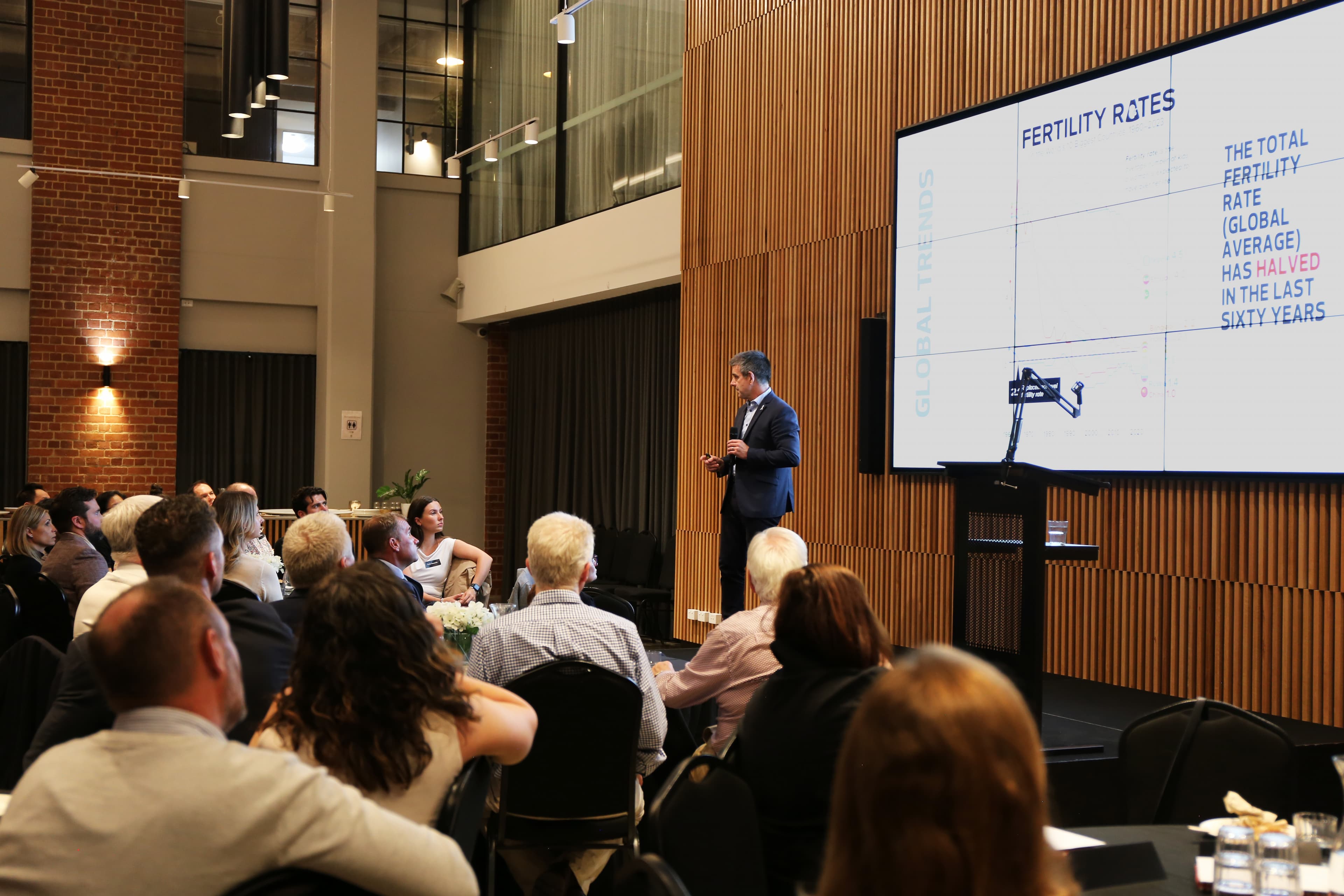
We were lucky to be joined by Carl Davidson, a renowned social scientist, researcher and Senior Adjunct Fellow at the University of Canterbury’s Business School, who walked us through what he calls the "Fourth Demographic Transition". If you thought demography was just about dry population charts, Carl proved otherwise. He argued that Australia and New Zealand are facing a dual phenomenon of hyper-ageing and fertility implosion.
Carl noted that while Australia’s population has exploded from 7 million to 27 million over the last 80 years, that growth is now driven almost exclusively by migration rather than natural increase. With our fertility rate sitting at around 1.5, well below the replacement level, we are on a similar trajectory to Japan. The definition of "family" is changing, becoming "more vertical and less horizontal," meaning in the future, it’s more likely a child will have a great-grandparent than a first cousin. It was a compelling look at how the fundamental structure of our customer base and workforce is shifting under our feet.
Beyond population, Carl drilled down into how we live and connect, introducing us to the concept of "primate cities". Carl spoke of the pressures placed on resources and lifestyle as a direct result of the intense concentration of our population in urban hubs, such as 77% of Victorians living in Melbourne.
Perhaps most impactful to me was the discussion on the decline of "social capital" and the disappearance of "Third Places", those community locations that aren't work and aren't home. Carl shared research suggesting nearly half of us now lack a Third Place, correlated directly to the rising rates of loneliness. Counter-intuitively, this loneliness is now statistically higher among young people than the elderly. Carl eloquently painted a picture of a digitally connected but socially fragmented society, challenging us to think about how we build genuine connection in an increasingly isolated world.
We walked away from the event with a sharpened focus on the realities that will define the years to come and plenty more to think about. It’s clear that the future won’t follow the neat linear patterns of the past, and relying on old assumptions is a risky strategy, however, the insights shared by Carl also reinforced that our organisation is well-positioned to navigate these shifts.